
Early Life and Training
Edgar Bergen, born Edgar John Berggren in Chicago to Swedish immigrant parents, taught himself the rudiments of ventriloquism at age eleven from a pamphlet called The Wizard's Manual. His father died when Bergen was sixteen, and he worked a string of odd jobs — accountant's apprentice, furnace stoker, movie projectionist — before the established ventriloquist Harry Lester took him on, giving him near-daily lessons for three months.
In 1919, still a teenager, Bergen paid Chicago woodcarver Theodore Mack $36 to carve the head of a grinning, red-haired newspaper boy he knew. Bergen built the body himself, using a length of broomstick for the spine and rubber bands and cords to work the jaw. He named the figure Charlie McCarthy, and it stayed with him for the rest of his career. He studied speech and drama at Northwestern University without finishing his degree, then spent summers on the Chautauqua circuit before shortening his stage name from Berggren to Bergen.
The Chase and Sanborn Years
Bergen and Charlie were spotted performing at New York's Rainbow Room and parlayed that into a guest slot on Rudy Vallée's radio program in December 1936. The appearance led to a regular berth on The Chase and Sanborn Hour, which ran under various sponsors from 1937 to 1956 — an extraordinary run for an act built entirely on an unseen visual trick. Bergen expanded his roster of characters for radio, adding the dim-witted Mortimer Snerd and the romantically hopeful Effie Klinker, but Charlie remained the breakout personality: a wisecracking, girl-crazy dandy in top hat and monocle whose double entendres slipped past broadcast censors because they came from a puppet.
Bergen's on-air sparring partners included W. C. Fields, whose running feud with Charlie became a signature bit, and Mae West, whose 1937 exchange with Charlie was controversial enough to draw NBC censure. The show's popularity is sometimes credited with an odd historical footnote: on the night Orson Welles broadcast War of the Worlds in 1938, much of the listening public had Bergen's program on instead, and only tuned to Welles' broadcast, mid-panic, once Bergen's musical interlude sent them dial-hunting.
Bergen was, by his own show's running joke, not a technically clean ventriloquist — Charlie regularly needled him about moving his lips. What carried the act was comic timing and the sharpness of the characters' writing, proof that on radio the illusion of a genuine second personality mattered more than any physical technique.
Film, Television, and Later Career
Bergen and Charlie received top billing in several films, including The Goldwyn Follies (1938) and You Can't Cheat an Honest Man (1938) opposite W. C. Fields, and appeared in Walt Disney's Fun and Fancy Free (1947). In 1937, the Academy of Motion Picture Arts and Sciences gave Bergen an Honorary Oscar in the unusual form of a wooden statuette, honoring his creation of Charlie McCarthy — reportedly the only wooden Oscar ever awarded. Bergen also worked as a straight actor, notably as the timid suitor Mr. Thorkelson in I Remember Mama (1948).
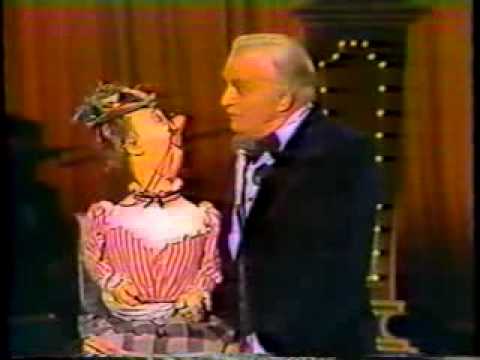
Television never gave Bergen and Charlie the same dominance radio had, but he appeared widely across the medium for decades, hosting the game show Do You Trust Your Wife? and turning up as a mystery guest on What's My Line?. He introduced a new character for television, the life-size Southern belle Podine Puffington, in a 1950 Thanksgiving special. In 1977 he guest-starred on The Muppet Show, a program whose creator, Jim Henson, considered Bergen a formative influence.
Death and Legacy
In September 1978, Bergen announced his retirement, donated Charlie McCarthy to the Smithsonian's National Museum of American History, and opened a farewell engagement for Andy Williams at Caesars Palace in Las Vegas. He died three days later, on September 30, 1978, of kidney disease, and was buried under his family's original surname, Berggren, at Inglewood Park Cemetery. His final screen appearance, in The Muppet Movie (1979), was dedicated to his memory.
Bergen was elected to the Radio Hall of Fame in 1990, and the U.S. Postal Service issued a commemorative stamp in his honor in 1991. He holds three stars on the Hollywood Walk of Fame, for radio, film, and television. His daughter, actress Candice Bergen, later wrote that he left his estate largely to her but bequeathed $10,000 directly to Charlie McCarthy, a detail she described as emblematic of a complicated relationship in which the dummy sometimes seemed to hold a stronger claim on her father's affection than she did.
Figures
- Charlie McCarthy
- Mortimer Snerd
- Effie Klinker
- Podine Puffington
Timeline
- 1919 — Commissioned Theodore Mack to carve the head of Charlie McCarthy for $36.
- 1922–1925 — Performed each summer on the Chautauqua circuit and at Chicago's Lyceum theater.
- 1936 — Guest appearance with Charlie on Rudy Vallée's radio program led to a regular network slot.
- 1937 — Joined the cast of The Chase and Sanborn Hour, which ran under various sponsors until 1956.
- 1937 — Received an Honorary Academy Award (a wooden Oscar statuette) for creating Charlie McCarthy.
- 1938 — Appeared with Charlie in The Goldwyn Follies and You Can't Cheat an Honest Man.
- 1949 — Moved to CBS with The Charlie McCarthy Show, sponsored by Coca-Cola.
- 1956 — Ended his long-running radio/TV variety program as television sponsorship shifted away from the format.
- 1960 — Inducted into the Hollywood Walk of Fame with three stars, for radio, film, and television.
- 1977 — Guest-starred on The Muppet Show, season 2.
- 1978 — Retired, donated Charlie McCarthy to the Smithsonian, and died three days into a farewell Las Vegas engagement.
- 1990 — Elected to the Radio Hall of Fame.
Watch

On video
28 performances cataloged in our archive. needs research: curate + embed the best 5–8; the rest 301 here
Sources
- Edgar Bergen — Wikipedia. Accessed 2026-08-13.
- The Dummy Blog archive — Edgar Bergen — The Dummy Blog. Accessed 2026-08-13.
Spotted an error, or know something we don't? Tell us — corrections are credited.